
Monthly Archives: August 2011

Do You Have the Proper Perspective in Recruiting?

Perception and PerspectiveIt is all too easy for sourcers, recruiters, HR professionals, and hiring managers/teams to develop a skewed, distorted, and decidedly one-way view of the world. Perhaps spending 99% of the time on only one side of the recruiting process is to blame.

Regardless of the cause, it is absolutely critical to regularly take the time and think about, understand, and appreciate the recruiting life cycle from the candidate’s side – the job seeker, the passive candidate, the non-job seeker, and the elusive “A+ player.”

In this article I’m going to walk you through over 10 different scenarios in which I think recruiters and hiring teams can benefit greatly by taking the candidate’s perspective into careful consideration.

If you don’t take well to being challenged to think differently from time to time, or if you don’t like long blog posts, you may not want to read any further. This one clocks in at 3700+ words.

Consider yourself warned. :-)
Continue reading

How to Search for Top Students and GPA’s on LinkedIn

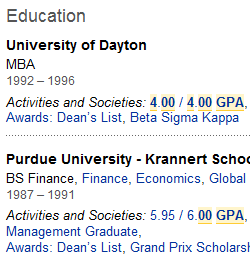
Have you ever wanted or needed to search for top students of people who have achieved high grade point averages in high school or college?

While GPA is relatively unimportant to many employers – to others, a high GPA is indicative of a person’s ability to achieve results in an unstructured environment (no one is there making you go to class or study for your exams), which can provide clues to self-management capability and the drive to excel.

Some employers simply won’t hire candidates for certain roles without a specific GPA or higher, with few exceptions (e.g. Google).

Regardless of your personal philosophy on the (in)significance of GPA’s, a grade point average is an objective measure of performance and achievement, and one of the very few that can be found on a resume or a social media profile. Continue reading

All Recruiting Sources Are NOT Created Equal

While there is much written on the subject of how to search the various talent sources available to recruiters and sourcers today, such as the Internet, LinkedIn, Facebook, Twitter, Google+, ATS/CRM systems, etc., there does not seem to be much written about their ROI as sources of talent/human capital information.

I believe that the value of any source of information is 50% based upon the actual information contained within (data depth), and 50% in the ability to extract out precisely and completely what the user needs (searchability). Information has no value if you are unable to easily access, effectively search for and find what you need and take action on it.

When it comes to leveraging information systems for talent identification and acquisition, it is critical to assess the depth of the talent/human capital data offered by the source as well as how “searchable” the source is.

Why is Data Depth and Searchability Important?

Quite simply, the deeper the data offered by and the more searchable the the source is, the higher the ROI for your sourcing efforts.

All electronic sources of talent are NOT created equal, and some offer sourcers and recruiters instrinsic advantages with regard to the ability to more quickly and precisely find more of the right people, yielding higher productivity.

I’ve created a graphic representation of a comparison of the data depth and searchability of the most common information systems used by sourcers and recruiters to find candidates. Continue reading

How to Find and Identify Active Job Seekers on LinkedIn

I’ve received a few inquiries over the past month regarding how to find active job seekers on LinkedIn.

This isn’t something I do, nor have I ever tried to do it, so I didn’t have any read-made search suggestions for these folks.

I don’t recruit people because they are looking to make a move – I recruit people based on their skills, experience and critical intangibles. I could care less if they are looking or if the thought of leaving their current employer is the furthest thing from their mind.

In my opinion and experience, everyone is a candidate and anyone can be recruited if you have a great match between their skills, experience and interests and the opportunity you’re looking to fill.

Having said all that, if you want to search LinkedIn to identify people who are highly likely to be actively seeking employment, you have a few options. Continue reading