Monthly Archives: January 2011

18 LinkedIn Apps, Tools, and Resources

I tweeted the other day about LinkedIn’s Resume Builder and I got a number of surprising responses from people I would have assumed would already know that LinkedIn had a resume builder.

LinkedIn has been cranking out new features and tools, and I realize that it’s too easy for me to assume that everyone else knows what I know, so I’m compiling all of the interesting offerings LinkedIn has released in 1 place for easy consumption.

While you may be familiar with some of them, I can almost guarantee you aren’t familiar with ALL of them.

I’ll start with LinkedIn Labs offerings and then cover Outlook, Jobs Insider, Internet Explorer, Firefox and Google toolbars, LinkedIn mobile solutions, the Lotus Notes widget, sharing bookmarklets, emails signatures, the Mac search widget, and LinkedIn Ads.

Resume Builder

I’ve been waiting for this for a LONG time, and I wasn’t surprised to see LinkedIn create a resume builder that allows people to turn their LinkedIn profiles into Word and PDF resumes.

It’s as easy as  picking a template, editing and arranging the information, and exporting and printing or sharing via email, LinkedIn, Facebook, or Twitter. Continue reading

Does LinkedIn Offer Recruiters Any Competitive Advantage?

When I spoke at the LinkedIn Talent Connect event last year, I dropped a big question on the 500+ audience:

“What’s your informational and competitive advantage when you all have access to the same people?”

Think about it.

If you have a LinkedIn Recruiter account (over 55% of the Fortune 100 do!), you have access to view any and all LinkedIn profiles.

So do your competitors that are hunting to identify and recruit the same talent.

Regardless of your LinkedIn account type (Free, Business, Business Plus, Executive, Pro, Talent Basic, Talent Finder, Talent Pro, or Recruiter), you still have access to viewing any and all public profiles, although you just might have to jump through some flaming hoops with a small network and a free account. :-)

So now I will ask you – if the majority of sourcers, recruiters and human resources professionals in the world use LinkedIn for sourcing and talent acquisition (there’s nearly a million!), what’s your competitive advantage over your rivals? Continue reading

Have You Analyzed the Value of Your LinkedIn Network?

When someone connects to you on LinkedIn, they gain the benefit of any non-overlapping  network connections from your first and second degree network. Your first degree connections become their second, and your second degree connections become their third.

Have you ever taken a look at your LinkedIn network at the first and second to see what your network value proposition is to people who may be interested in connecting with you?

Eric Jaquith has, and now so have I.

I highly recommend you do the same.

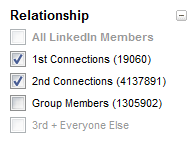
Using LinkedIn’s filters, I ran a search with no keywords for all of LinkedIn, selecting only my 1st and 2nd degree connections – no groups or “3rd + Everyone Else.” Here’s what my network looks like at the 1st and 2nd degree, from the perspective of the top 10 locations, industries, current companies, and past companies, as well as years of experience, seniority level, and Fortune 1000 rank. Continue reading

Will 2011 be a Big Year for Recruiters and Social Media?

I read a brief sidebar article in the November 1, 2010 Fortune magazine that detailed the hottest jobs of 2010 and I was pleased with what I saw, and I thought you would be too.

Apparently, Fortune worked with “LinkedIn’s top data crunchers” to pull some exclusive information about the job titles that saw the biggest percentage increase in 2010 over 2009.

Here are the 10 titles they listed:

  1. Social Media Manager
  2. Principal Sales Consultant
  3. Recruitment Officer
  4. Digital Designer
  5. M&A Analyst
  6. Investment Banking Analyst
  7. Junior Software Engineer
  8. Technical Recruiter
  9. Transition Manager
  10. Corporate Communications Manager

Recruiting and Social Media

It doesn’t take a rocket scientist to see a few themes here:

  1. Social Media Manager, Corporate Communications Manager
  2. Recruitment Officer, Technical Recruiter
  3. M&A Analyst, Investment Banking Analyst

Yes, I know some people might say that the tie between Social Media Manager and Corporate Communications Manager might be weak – but not necessarily.

Who is to say that Corporate Communications Managers can’t/don’t use Socialtext, Yammer, Confluence, Drupal, Jive, Novell Vibe or Salesforce Chatter to push corporate communications? Many already do! Continue reading

Boolean Search String Experiment #2

Cyborg Sourcer

Back in November, I posted a Boolean search challenge to demonstrate that when you give a number of sourcers and recruiters the same job description/hiring profile to search for, you will get as many different searches and search strategies as you have sourcers and recruiters.

As I have said many times before, every search string “works,” provided they are syntactically correct.

However, not all search strings or strategies are created equal, nor are the results that are returned.

Because of this fact, 20 different sourcers and recruiters searching the same source (LinkedIn, the Internet, Monster, etc.) will find some of the same candidates, but each will also find some that the others do not.

The most important question to ask is anyone actually finding all of the best candidates that the particular source has to offer? Believe it or not, some of the best candidates are never found by the people who are searching for them. You can’t be aware of something your searches do not return.

Or can you?

Information Retrieval is the Key

When it comes to information retrieval– which is the science of searching for documents (e.g., resumes, press releases, etc.), for information within documents (e.g., experience and qualifications), as well as searching relational databases and the Internet – simply having access to the information does not afford a sourcer, recruiter or organization any competitive advantage.

However, human capital informational and competitive advantage can be achieved through more effective retrieval – in other words, more effective queries (i.e., Boolean search strings).

Queries are formal statements of information needs. When searching to identify talent, the more effective you are at translating your information needs (skills, experience, qualifications, etc.) into queries, the more likely you are to find all of the best candidates any particular source of talent has to offer. Continue reading

Do You Really Know the Size of Your LinkedIn Network?


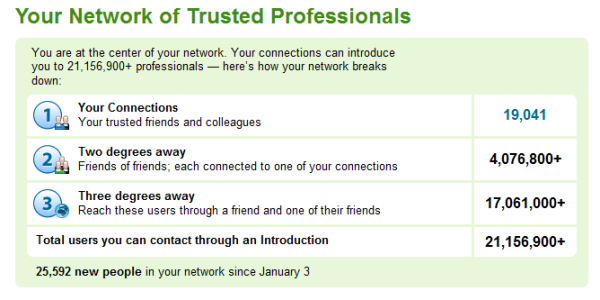
When people talk about the size of their LinkedIn network, many make reference to the “Total users you can contact through an Introduction” number, which is the total of the 1st, 2nd and 3rd degree connections.

However, many people don’t know that the number representing LinkedIn users three degrees away from you is just an estimate.

Yes, you read that right – it’s not the actual number of your 3rd degree connections on LinkedIn. Which means the total number is also an estimate. Continue reading