
Monthly Archives: November 2010

Is Finding and Recruiting Top Talent Really Your #1 Priority?

Do these quotes sound familiar?

  • “People are our greatest asset.”
  • “The only real sustainable competitive advantage of any company is the recruitment and retention of great people.”
  • “Talent is our #1 priority as a company.”
  • “Your technologies, products and structures can be copied by competitors, but your people can’t be.”
  • “No matter what kind of business you are in, having the right people determines your company’s success or failure.”
  • “The ability to find and hire the right people can make or break your business. It is as plain as that. No matter where you are in the life cycle of your business, bringing in great talent should always be a top priority.” – Michael Dell

How many times have you read or heard something similar?

The ubiquitous “people are our greatest asset” sentiment sounds good, and no doubt feels good to say, but whenever I hear or read it, the first question that comes to my mind is “What are you doing to ensure that you are identifying and acquiring the right people?”

If you believe that finding and acquiring top talent is your #1 priority, then I have a few questions for you.

Continue reading

Sourcing is Not an Entry Level Function or Role

I recently listened to an interview with DeeDee Doke of Recruiter.co.uk in which she related to Amybeth Hale that the perception in the U.K. is that sourcing is an entry level career in the recruiting industry.

Apparently, using information systems for talent discovery and identification is perceived by many as a junior role and skill across the pond.

I’m saddened by this, and what makes it worse is that this sentiment isn’t limited to the U.K. – there are plenty of people in the U.S. as well as the rest of the world who feel the same way.

This perception most likely comes primarily from the fact that many people don’t really yet understand, appreciate or know how to fully leverage the latent power of human capital data.

Yes, there is deep latent power hiding in data of all forms – all you need to do is take a look at business intelligence solutions and how much money companies spend on them (millions) to get a basic appreciation of the power of data.

Unfortunately, it doesn’t seem that many companies value human capital data in the same manner that they value their sales, product and customer data.  Continue reading

LinkedIn Profile Search Engine Optimization / SEO

I recently wrote about what happens when you search for yourself on LinkedIn.

Now I’d like to address what happens when people don’t search for you by name, but rather try to find people like you using “regular” keywords and titles.

When it comes to Internet search, the goal for most people and companies is to be on the first page of search results for your keywords, and ideally #1 if at all possible.

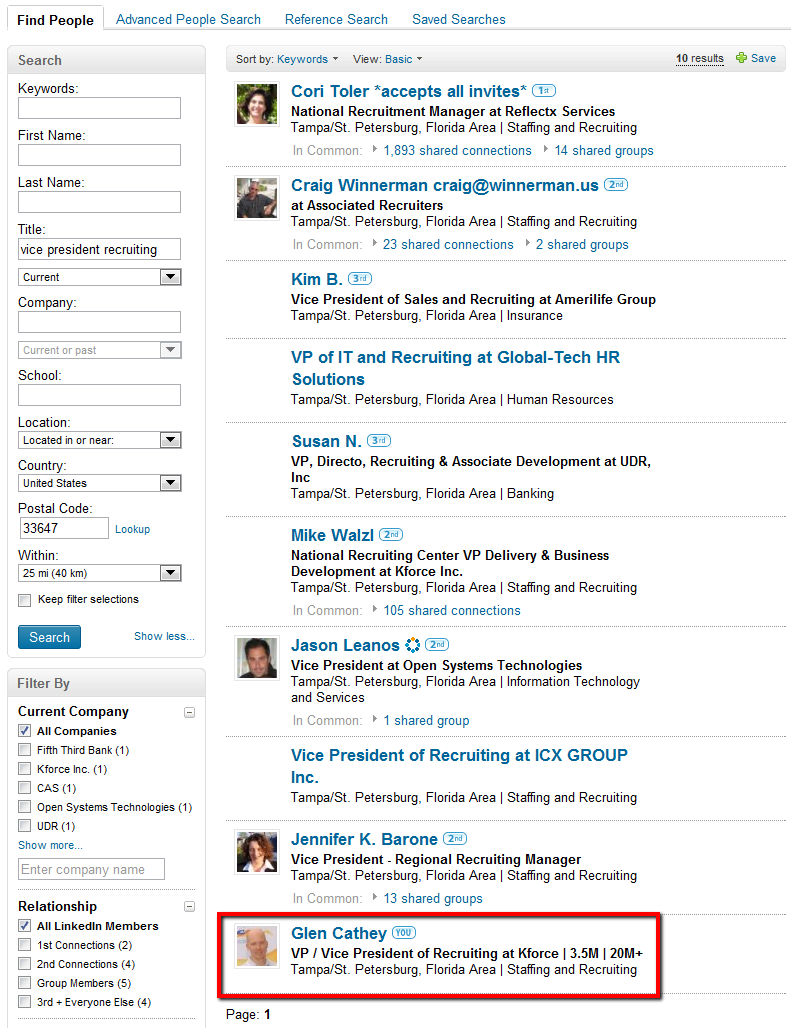
When you search LinkedIn with the titles you have on your profile and keywords you’ve mentioned in your metro area, do you show up in the first 10 results?

Have you ever wondered if there was anything you could do to positively affect your ranking in search results when someone searches LinkedIn looking for people like you? Have you seen heavily keyword-loaded LinkedIn profiles and wondered if it really does any good?

You could get lost in all of the YouTube videos and blog posts on the subject of LinkedIn profile optimization, but most of it is pure speculation.

Before I go into some detail as to what I think is going on with LinkedIn search ranking and what you might be able to do to positively affect your ranking, I’d like to show you a little experiment I’ve run and ask you to do something similar and see what happens.

You have searched or have had someone else search LinkedIn by the titles and keywords you used on your profile to see where you rank, haven’t you? Continue reading

Boolean Search String Experiment – Are You Game?

Cyborg SourcerOne of the most interesting yet overlooked aspects associated with sourcing candidates using the Internet, job board databases, ATS/CRM systems and social networks such as LinkedIn is that as long as your syntax is correct, every search “works.”

This fact leads (too) many people to believe that finding talent online is easy and that there is no competitive advantage to be gained in the practice of searching human capital data.

However, are all queries created equal?

Would 5 different recruiters working the same position use the same search strings and search strategy? Would they find the same people if they used the same source?

In many organizations, sourcers and recruiters do not get (or seek out) the opportunity to compare and contrast their search strategies and tactics with their peers and/or managers on a position-by-position basis. Much of the magic of talent discovery and identification, or lack thereof, happens on each person’s computer screen.

Unlike professional athletes and musicians whose skills and techniques are on display and scientists who publish their work, sourcers and recruiters responsible for talent discovery have absolutely no public basis of comparison. Continue reading

Free LinkedIn Profile Optimization and Job Seeker Advice

I watched a YouTube video the other day in which someone was charging job seekers for LinkedIn profile optimization.

It bothered me.

While I appreciate capitalism and don’t fault people for recognizing and seizing an opportunity, I think that in today’s economy, job seekers deserve all of the help they can get, and the currently unemployed certainly don’t need another expense.

Seeing that YouTube video inspired me to create a series of six videos sharing my knowledge of LinkedIn Groups, Jobs, Companies, profile optimization and Internet research to help people make better use of LinkedIn in their current and future job search efforts. Continue reading